Markets
Apple and OpenAI are moving from AI partners to rivals as a trade-secret lawsuit and new AI hardware ambitions intensify competition.
Apple vs. OpenAI: From AI Partners to Fierce Rivals in the
Race for the Future
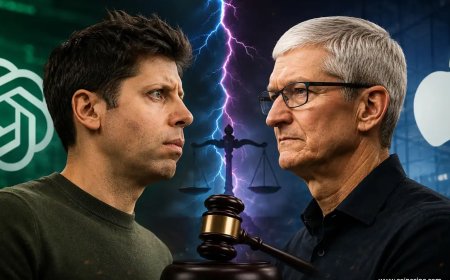
The relationship between Apple and OpenAI has taken a dramatic turn. Once positioned as strategic partners in artificial intelligence, the two technology giants are now locked in a legal and competitive confrontation over AI hardware, talent, and alleged trade-secret misuse.
Apple has accused OpenAI of using confidential information allegedly obtained through former Apple employees to accelerate its consumer-hardware ambitions. OpenAI has strongly rejected the accusations, calling Apple's claims unfounded.
The dispute highlights a much larger shift: AI is moving from software into consumer hardware, potentially putting OpenAI directly into competition with Apple's core business.
How the Partnership Turned Into a Rivalry
Apple and OpenAI previously worked together on integrating ChatGPT into Apple Intelligence and Siri. That relationship gave Apple users direct access to OpenAI's technology through Apple's ecosystem.
However, tensions increased as OpenAI began expanding into consumer hardware.
A major turning point was OpenAI's acquisition of io, a hardware company founded by former Apple design chief Jony Ive. OpenAI also recruited hundreds of former Apple employees, including executives involved in hardware development.
Apple now argues that some former employees improperly accessed or transferred confidential information.
Apple Takes OpenAI to Court
Apple filed a lawsuit in federal court alleging that OpenAI and former Apple employees misappropriated confidential information to support OpenAI's hardware ambitions.
Apple has requested a preliminary injunction and expedited discovery, seeking access to documents and testimony related to the alleged misuse of its information.
OpenAI has rejected the allegations and says it has neither Apple's trade secrets nor any need for them. The company has also accused Apple of escalating the dispute unnecessarily.
The legal battle is still developing, so the allegations should not be treated as established facts.
Why AI Hardware Is the Real Battlefield
The dispute goes beyond employee movement and trade secrets.
Both companies are preparing for a future in which AI assistants could become embedded directly into everyday devices.
Apple's strategy
Apple is working to integrate AI more deeply into products such as:
- iPhone
- Siri
- AirPods
- Smart glasses
- Other connected consumer devices
OpenAI's strategy
OpenAI is increasingly moving beyond chatbots and AI models toward purpose-built consumer hardware.
The company's relationship with Jony Ive and its acquisition of io are particularly important because Ive played a major role in Apple's hardware and industrial-design history.
Why This Matters for the Tech Industry
The Apple–OpenAI dispute could influence the direction of the next generation of consumer technology.
| Area | Apple | OpenAI |
|---|---|---|
| Core strength | Consumer hardware & ecosystem | AI models & software |
| AI assistant | Siri / Apple Intelligence | ChatGPT |
| Hardware strategy | Existing global device ecosystem | New AI-native devices |
| Design expertise | Decades of experience | Jony Ive / io partnership |
| Key challenge | Catching up in AI | Entering hardware |
The competition could ultimately determine whether the next major computing platform remains the smartphone or shifts toward AI-native devices.
The Talent War Is Intensifying
Talent has become one of the most valuable assets in the AI industry.
Apple claims that more than 400 former Apple employees now work at OpenAI, according to reporting cited by Newsbit.
The movement of senior engineers and designers is especially significant because AI hardware requires expertise across:
- Industrial design
- Semiconductor engineering
- Software
- AI models
- User interfaces
- Supply chains
- Consumer electronics
This makes employee movement a strategic issue rather than simply a hiring trend.
Market Signals
Bullish for AI
Competition between major technology companies could accelerate innovation.
AI-native hardware could create an entirely new consumer category.
Apple's massive ecosystem provides a powerful distribution channel for AI.
OpenAI's model expertise gives it a strong foundation for intelligent devices.
Risks
The legal dispute could slow hardware development.
Talent competition may increase costs across the AI industry.
Consumer AI hardware remains an emerging market.
Regulatory and intellectual-property disputes could become more common.
What Could Happen Next?
1. The Legal Battle Continues
Apple is seeking preliminary relief while OpenAI is challenging the allegations. The outcome could determine how quickly OpenAI can move forward with certain hardware initiatives.
2. OpenAI Pushes Further Into Hardware
The company's partnership with Jony Ive suggests that OpenAI wants to build products designed around AI from the beginning rather than simply adding AI to existing devices.
3. Apple Accelerates Its AI Strategy
Apple's dependence on external AI providers has become increasingly important as it works to strengthen Siri and Apple Intelligence. Recent reporting indicates Apple has also turned to Google's Gemini technology for its next-generation Siri strategy.
4. The Smartphone Could Face a New Challenger
If AI-native hardware becomes successful, companies such as Apple, OpenAI, Google, Meta, and others could compete to define the next major consumer computing platform.
Bigger Picture: The AI Industry Is Entering Its Hardware Era
The Apple–OpenAI conflict demonstrates how quickly the AI competitive landscape is changing.
The first phase of the AI race focused primarily on:
Models → Chatbots → APIs → Cloud infrastructure
The next phase could focus on:
AI models → Agents → Devices → Personal computing
That shift puts AI companies directly against established hardware giants.
What Investors Should Watch
Key developments include:
- Apple's ongoing lawsuit against OpenAI.
- OpenAI's consumer-hardware roadmap.
- Jony Ive's role in OpenAI's hardware strategy.
- Apple's next-generation Siri.
- AI-native device launches.
- Movement of senior AI and hardware talent.
- The impact of AI competition on Apple and OpenAI valuations.
Final Take
The relationship between Apple and OpenAI has evolved from strategic cooperation into an increasingly direct rivalry.
Their legal dispute is only one part of a much larger battle. Apple controls one of the world's most powerful consumer-device ecosystems, while OpenAI possesses significant expertise in generative AI. As OpenAI moves into hardware and Apple works to strengthen its AI capabilities, their interests are increasingly colliding.
The biggest question may no longer be who builds the best AI model. It may be who controls the device through which billions of people interact with AI every day.